What Is a Neural Processing Unit (NPU)?
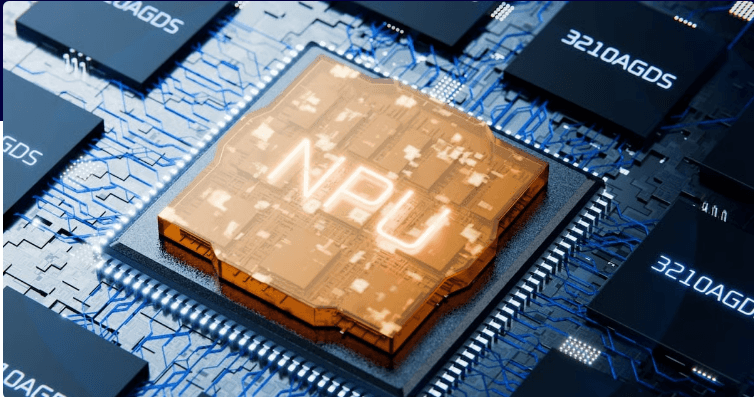
A neural processing unit is a type of AI chip designed to handle the complex computations involved in deep learning, a method that teaches computers to learn and make decisions by mimicking how the human brain works. To that end, they are specifically optimized for neural networks, which are inspired by the structure and function of the human brain itself.
While NPUs can certainly be used to train neural networks, they’re particularly well-suited for inference, where a trained AI model analyzes new data to make predictions or decisions. Like neurons in the brain, the nodes within an NPU communicate by passing information to one another. By adjusting the strength of the synapses connecting the nodes, the network learns to identify patterns and relationships, improving its ability to make accurate inferences over time.
Focusing on neural network workloads, NPUs deliver high performance and energy efficiency in AI tasks. And unlike other chips, they combine both memory and computation capabilities on the same chip, enabling them to process data locally without sending it to the cloud. This makes them ideal for real-time, on-device applications, like telling an autonomous vehicle to swerve around an object in the road.
NPUs also excel at tasks like image recognition, object detection, and natural language processing. They are what allow you to blur your background on a video call, unlock your phone with facial recognition or seek advice from voice assistants like Siri or Alexa.
Neural processing units are typically integrated into a larger system-on-chip (SoC) configuration, where they work alongside more general-purpose chips like CPUs or GPUs. In this setup, the NPU handles the AI-specific tasks, freeing up the other semiconductors to perform other tasks. How Do NPUs Work?
NPUs are significantly better at AI tasks than CPUs and GPUs — and they use far less energy in the process. This performance advantage largely comes down to how they are designed.
While the CPU for a laptop may have around four cores, a single NPU contains thousands of tiny processing units called multiplication-accumulate (MAC) units that perform basic calculations, multiplying two numbers and then adding the result. MAC units are optimized for low-precision mathematical computations, which boosts memory and energy efficiency, with only marginal impacts to model accuracy.
The MAC units in an NPU are typically arranged in a grid-like pattern known as a systolic array. This architecture enables parallel processing, allowing the chip to carry out thousands — even trillions — of computations at the same time. This capability is especially useful for matrix multiplication, a fundamental operation in neural networks that lets them process large amounts of data quickly and at scale.
In addition to MAC units, NPUs have other purpose-built modules for applying activation functions, decompressing data and other tasks.
Another key advantage is that NPUs integrate high-bandwidth memory directly on the chip, which allows smaller AI models to operate right on the edge. Because the chip can access data locally, it requires less bandwidth, responds to requests faster and offers better privacy than sending data to the cloud. This is particularly useful in devices like smartphones and IoT applications.
NPUs vs. CPUs vs. GPUs vs. TPUs
Central Processing Unit (CPU)
Central processing units (CPUs) provide the primary computing power for most computers. They’re often referred to as the brain of a computer, as they execute commands, run programs and distribute computing resources. A CPU may have only four or 12 powerful cores, whereas an NPU may have thousands of smaller cores. And unlike NPUs, CPUs can only process data sequentially, not in parallel. While a CPU may be able to handle smaller automation workloads, AI tasks are typically reserved for GPUs, NPUs and TPUs.
Graphics Processing Unit (GPU)
Graphics processing units (GPUs) were developed to handle graphics-heavy tasks, like video gameplay and video playback. In recent years, they have also been used to power the generative AI revolution, with some companies buying thousands of GPUs to train their models. Like NPUs, their parallel processing abilities allow them to handle advanced AI workloads — including in data centers. But GPUs require more energy than NPUs, so NPUs are the preferred choice for powering neural networks locally on smartphones and other edge devices.
Tensor Processing Unit (TPU)
Designed by Google, tensor processing units (TPUs) are an application-specific integrated circuit (ASIC) specialized for neural networks. They’re similar to NPUs in that way, but they have different uses. TPUs are typically deployed at data-center scale for cloud computing, whereas NPUs are built for energy efficiency, making them more suitable for edge devices.